
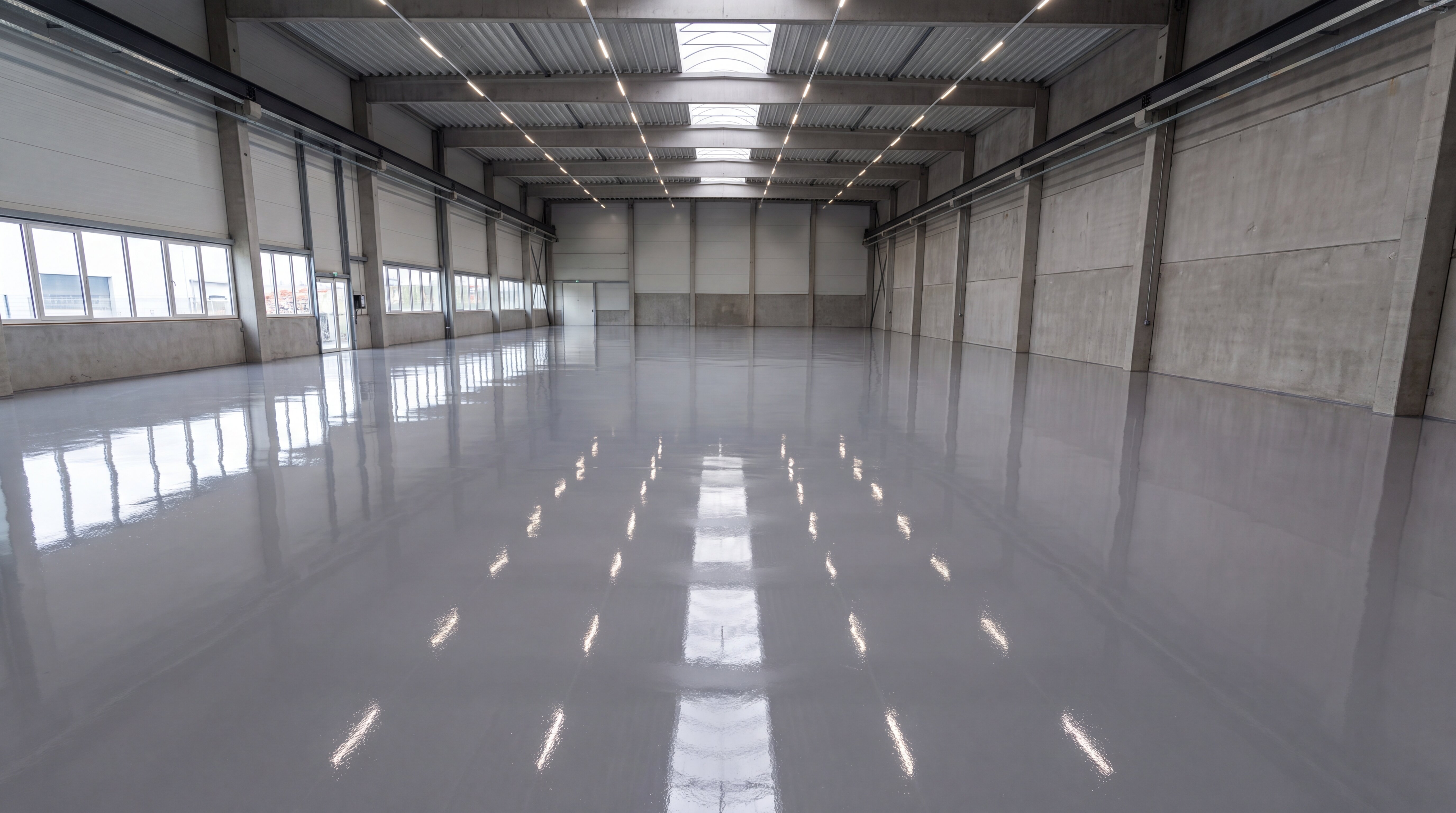
Floor Preparation and Repair in Surrey
Poor preparation causes more resin floor failures than any other factor. We have seen it hundreds of times across 15 years in Surrey: a contractor applies a quality resin system over contaminated, damp, or structurally weak concrete, and the floor delaminates within weeks. Proper preparation is not optional and it is not a line item to negotiate away. It is the entire foundation of a floor's longevity. We carry out full mechanical preparation, moisture assessment, crack repair, and substrate consolidation as a standalone service or as part of any resin flooring installation across Guildford, Leatherhead, Redhill, Farnham, and beyond.
The process begins with diamond grinding the concrete to remove all surface laitance, old adhesives, paints, and contamination, opening the pores to a CSP profile appropriate for the resin system being applied. On a recent job in Farnham, a Victorian terrace extension had been built on a poorly poured slab. Our moisture readings came back at over 90% RH. We applied a two-pack epoxy DPM before any further work. Without that step, the client's new poured resin floor would have suffered osmotic blistering within months. Getting preparation right is the difference between a floor that lasts 20 years and one that fails in 20 months.
Floor Preparation and Repair in Surrey Installation Process
Moisture and Structural Assessment
We use calibrated hygrometers and calcium chloride dishes to accurately measure relative humidity within the slab. Readings above 75% RH require a two-pack epoxy DPM rated to resist hydrostatic pressure. We also drag a hammer across the floor to check for hollow, delaminating screed. A hollow ring identifies sections that must be removed before any resin work proceeds.
Diamond Grinding
We use heavy-duty, dust-extracted planetary diamond grinders to remove laitance, old paint, tile adhesive, and surface contamination. The grinding process opens the concrete pores and achieves a CSP 3 or CSP 4 profile, the minimum standard for reliable mechanical adhesion of resin systems. All machinery connects directly to three-motor industrial HEPA vacuum units, keeping the process virtually dust-free.
Crack Chasing and Structural Repair
Static cracks are chased open with a diamond blade to a minimum 5mm width and depth, then blown clean and filled with low-viscosity structural epoxy resin. Expansion joints are respected, reformed, and sealed with flexible polyurea rather than rigid epoxy. This allows for ongoing thermal movement without cracking the new floor surface above.
Spall and Pothole Repair
Spalled concrete is cut square using angle grinders and filled with rapid-setting, high-strength epoxy mortar achieving over 60 N/mm² compressive strength. This creates a patch stronger than the surrounding concrete. It is fully bonded to the slab, not merely surface-applied.
Surface Levelling and Priming
Where the floor is uneven, we apply a pump-applied self-levelling cementitious compound or a trowelled epoxy scratch coat to create a perfectly flat canvas. Once level, a penetrating epoxy primer is applied to consolidate any remaining weak surface zones and provide a chemically receptive base for the resin system above.
Systems and Options
Our preparation and repair services cover every substrate condition we encounter:
- Mechanical Profiling: Diamond grinding and shot blasting to achieve the exact CSP required for the specified resin system. Shot blasting is used on large areas where speed matters; diamond grinding offers more precision around edges, drainage channels, and obstacles.
- Liquid Damp Proof Membranes: Two-pack epoxy DPMs applied to damp or green concrete to block moisture vapour transmission. Typically applied at 300 to 500 microns, these systems can tolerate RH readings up to 98% when applied correctly.
- Screed Consolidation Primers: Deep-penetrating epoxy or polyurethane primers used to bind weak, dusty, or friable sand-and-cement screeds, giving them sufficient tensile strength to hold a resin overlay without delamination.
Benefits of Floor Preparation and Repair in Surrey
- Guarantees long-term adhesion of any resin system applied above it
- Prevents blistering and delamination caused by moisture vapour transmission
- Stops existing cracks reflecting through the finished floor surface
- Creates a perfectly flat substrate for poured self-levelling resins
- Virtually dust-free process using industrial three-motor HEPA vacuum units
- Repairs damaged concrete to a compressive strength exceeding 60 N/mm²
- Identifies and resolves hidden problems before they become expensive failures
- Saves significant cost by salvaging damaged concrete rather than breaking it out and replacing it
Who Is Floor Preparation and Repair in Surrey Suitable For?
Floor preparation is essential for any Surrey property undergoing resin flooring installation, whether the substrate is a newly poured liquid screed in a Weybridge extension, a contaminated 1970s concrete slab in a Redhill garage, or an old sand-and-cement screed in a period property in Dorking. We assess every floor individually. There is no standard preparation recipe that suits all substrates.
We also carry out standalone preparation work for clients who are managing their own resin supply but need professional mechanical preparation completed before their contractor arrives. This is common on self-build projects and large residential developments across Surrey, where groundworkers pour the slab but the finishing trades need a properly profiled surface before they can begin.
Frequently Asked Questions
Ready to Get Started?
Request a free, no-obligation survey and quote. We cover all of Surrey and the South East.