
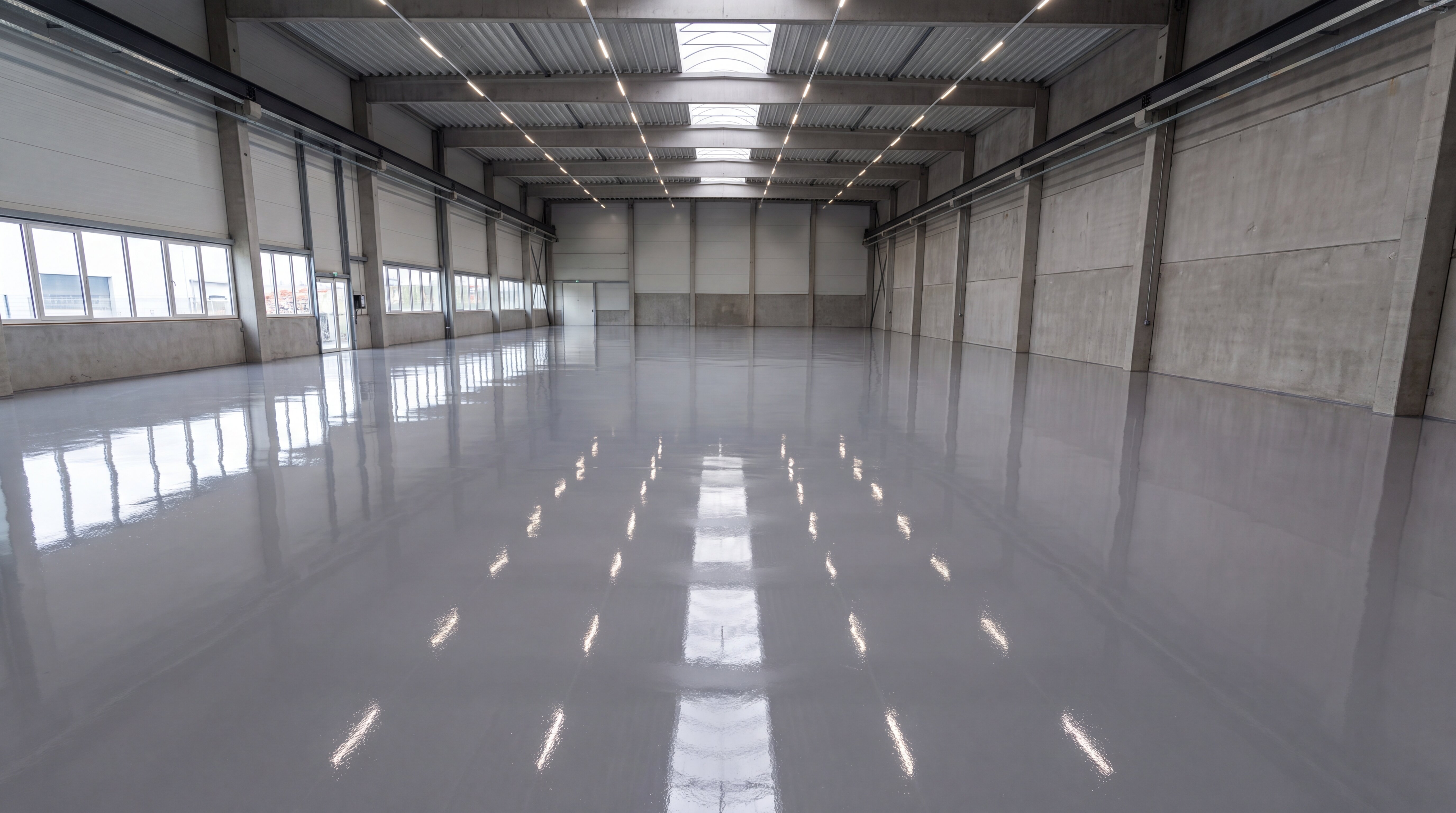
Resin Floor Repair and Refurbishment in Surrey
Floor refurbishment is one of the most cost-effective services we provide, and one of the most frequently deferred until a floor has deteriorated to the point where full replacement becomes the only option. A worn but well-bonded resin floor is an asset. It has a concrete substrate that has already been prepared and primed, an existing resin layer that provides additional compressive strength, and a bond to the slab that a new installation would need weeks to develop. We regularly extend the operational life of commercial floors in Guildford, Woking, and across the Horley logistics corridor by 5 to 10 years through targeted repair and recoating programmes, at a fraction of the cost of full removal and replacement.
The single most important diagnostic step in floor refurbishment is the pull-off adhesion test. This involves coring a small disc of the existing resin and applying calibrated tensile force to determine whether the coating is still bonded to the concrete at acceptable strength. Pull-off strength above 1.5 N/mm² means the floor is a refurbishment candidate. Below this threshold across significant areas, the coating is delaminating and patching will fail: full removal is necessary. A recent survey at a logistics unit on Broadmere Business Park in Woking confirmed strong pull-off across 85% of the floor area. A targeted repair and recoat programme was completed over one weekend, saving the client approximately 60% of what full replacement would have cost.
Resin Floor Repair and Refurbishment in Surrey Installation Process
Condition Assessment and Pull-Off Testing
We inspect the floor visually and carry out pull-off adhesion tests at multiple locations across the area. Delaminating sections show as low pull-off values below 1.5 N/mm², or fail cohesively in the concrete rather than the resin, indicating the substrate itself is weak. This data determines whether targeted repair is viable or whether full removal is required.
Mechanical Keying of the Existing Surface
If the existing coating is confirmed as well-bonded, we diamond grind the entire floor. This removes the top layer of UV damage, chemical contamination, rubber tyre marks, and surface scratches, and creates a rough profile that the new resin coat can mechanically key into. Applying a new coat over a polished, unkeyed surface will delaminate. This step is non-negotiable.
Targeted Crack, Joint, and Spall Repair
All identified damage is repaired before recoating. Cracks are chased open and injected with low-viscosity structural epoxy resin. Expansion joints with crumbling arises are cut back and rebuilt with rapid-setting epoxy mortar to over 60 N/mm² compressive strength, then resealed with flexible polyurea. Spalled potholes are cut square and filled flush.
Recoating
A fresh layer of high-build epoxy or polyurethane resin is applied over the prepared surface, encapsulating all repairs and producing a seamless, visually consistent floor. The thickness and resin type of the recoat is matched to the remaining demands of the environment. Where anti-slip performance is required, quartz aggregate is broadcast into the wet recoat.
Line Marking and Final Inspection
If the demarcation scheme has been worn away or needs updating, fresh two-pack epoxy line marking is applied as part of the refurbishment programme. We carry out a final visual and adhesion inspection before handover and provide a written refurbishment report documenting the work completed, materials used, and expected forward lifespan.
Systems and Options
Refurbishment uses a range of targeted interventions depending on the floor's condition:
- Overcoating and Refresh: Diamond grinding the existing worn resin and applying a fresh high-build epoxy or PU topcoat. Restores colour, sheen, cleanability, and chemical resistance at typically 30 to 50% of new installation cost. Effective when the existing resin is well-bonded but surface-worn.
- Expansion Joint Rebuilding: The most common targeted repair in warehouses. Failed joint arises are cut back square, rebuilt with rapid-setting epoxy mortar, ground flush, and sealed with heavy-duty flexible polyurea. Protects forklift tyres and prevents progressive joint failure spreading into the adjacent slab.
- Patch Repairs: Isolated areas of delamination or chemical damage are cut out to a defined square or rectangular boundary, the exposed concrete is prepared and primed, and high-build epoxy or PU screed is applied flush with the surrounding floor. Correctly executed, the repair is invisible in the finished floor.
Benefits of Resin Floor Repair and Refurbishment in Surrey
- Typically 40 to 60% cheaper than full floor removal and replacement: a major cost saving for facilities managers
- Significantly reduces downtime compared to full replacement: refurbishment can often be completed in a single weekend
- Pull-off adhesion testing provides objective evidence of whether refurbishment is viable before committing to cost
- Rebuilt expansion joints eliminate forklift tyre damage and progressive concrete deterioration
- Restores a hygienic, non-porous, easy-to-clean surface that meets current hygiene and safety standards
- Patch repairs prevent isolated damage from spreading into the surrounding slab
- Updated line marking can be integrated into the refurbishment programme at no additional mobilisation cost
- Written refurbishment report provides documented evidence of floor condition and maintenance history
Who Is Resin Floor Repair and Refurbishment in Surrey Suitable For?
We work primarily with facilities managers, operations directors, and commercial property landlords across Surrey who have ageing warehouse, factory, or commercial floors showing visible wear but still structurally sound. Broadmere Business Park in Woking, Barwell Business Park in Leatherhead, and Slyfield Industrial Estate in Guildford are all areas where we have completed refurbishment programmes on facilities built in the 1980s and 1990s whose floors are reaching the end of their first coating cycle.
We also work with landlords across the Redhill, Epsom, and Camberley areas who are preparing industrial units for tenant reversion or new lettings. A worn, heavily marked floor reduces achieved rent and slows the letting process. A professionally refurbished floor with fresh line marking and a clean, consistent appearance recovers that loss at a fraction of full replacement cost. We provide condition reports that can be appended to lease dilapidations assessments as evidence of the standard of finish at handover.
Frequently Asked Questions
Ready to Get Started?
Request a free, no-obligation survey and quote. We cover all of Surrey and the South East.