
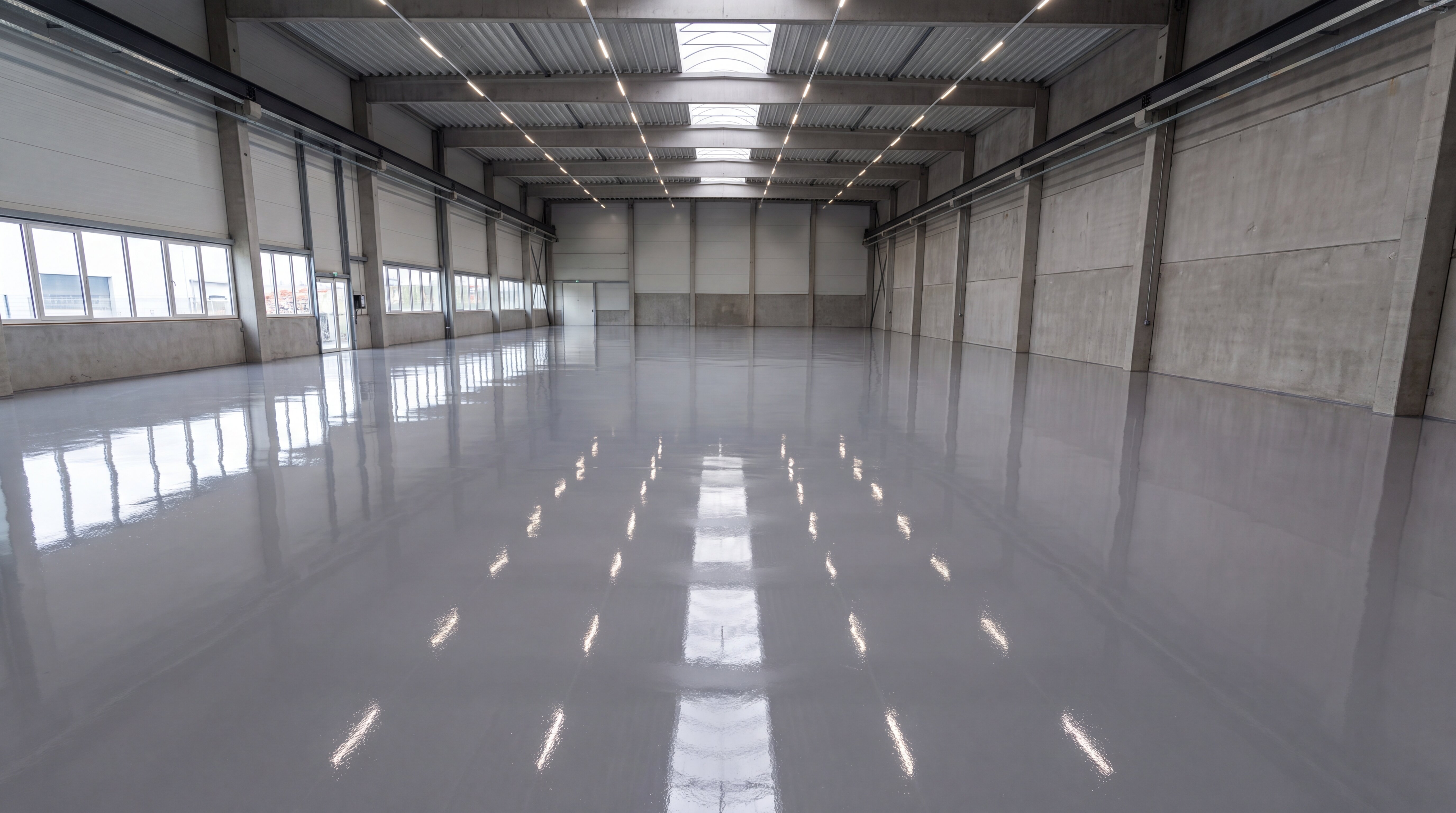
Warehouse Flooring in Surrey
Warehouse flooring is the job we price more than any other across Surrey's logistics and distribution sector. The county has a significant concentration of large-scale storage and distribution operations: Slyfield Industrial Estate in Guildford, Broadmere Business Park in Woking, and the Horley logistics corridor along the M23 all house facilities that depend on floors capable of handling counterbalance forklifts, VNA trucks, and pallet jacks continuously throughout the working day. Bare concrete dusts, degrades at expansion joints, and becomes a slip and contamination hazard. A high-build epoxy system seals the slab permanently, eliminates dust, and provides a semi-gloss reflective surface that measurably reduces the lighting load on a large shed.
The critical detail in warehouse flooring is joint treatment, not the coating itself. Expansion joints take a battering from loaded forklifts crossing them hundreds of times a day, and crumbling joint arises destroy forklift tyres and create a trip hazard. On a large job at a distribution unit in Woking last year, we rebuilt over 400 linear metres of failed joint arises with structural epoxy mortar before the coating went down. That repair work alone saved the client from ongoing tyre damage costs running into thousands of pounds annually. Getting the joints right is the difference between a floor that performs for 15 years and one that starts failing in 18 months.
Warehouse Flooring in Surrey Installation Process
Large-Scale Surface Preparation
We deploy ride-on shot blasters or large planetary diamond grinders to rapidly prepare expansive warehouse floors. These machines prepare 1,000 to 2,000 square metres per day, removing tyre rubber, oil contamination, old paints, and surface laitance to achieve a clean, porous concrete profile ready for resin bonding.
Expansion Joint Assessment and Repair
Every expansion joint is inspected. Damaged or crumbling joint arises are cut back square with diamond blades and rebuilt with rapid-setting, high-strength epoxy mortar achieving over 60 N/mm² compressive strength. The joint itself is then sealed with a heavy-duty flexible polyurea capable of accommodating ongoing thermal movement without cracking the new floor surface.
Crack and Pothole Repair
Isolated cracks are chased open and injected with low-viscosity structural epoxy resin. Potholes and spalled areas are cut square and filled with epoxy mortar, then ground flush with the surrounding slab. All repairs are completed before the coating is applied. No repairs are made after the coating goes down.
High-Build Epoxy Coating
A two-pack, high-build epoxy resin is applied by squeegee and back-rolled in two coats, achieving a total dry film thickness of 500 to 750 microns. This seals the concrete completely, provides compressive strength the slab cannot achieve alone, and creates a semi-gloss reflective surface that measurably improves lighting levels in the shed.
Line Marking and Demarcation
Once the coating has cured, two-pack epoxy line marking is applied for pedestrian walkways, forklift routes, staging zones, and racking bays. We work from client CAD layouts or create the demarcation scheme from scratch. Lines are masked with high-adhesion tape and applied at minimum 100 microns DFT, vastly more durable than thermoplastic or aerosol alternatives.
Systems and Options
We specify two primary systems for warehouse environments, depending on the traffic profile:
- High-Build Epoxy Roller Coat at 500 to 750 microns DFT: The standard for general warehousing and distribution. Two coats of high-build epoxy applied by squeegee and roller. Cost-effective over large areas, excellent chemical resistance, and a semi-gloss finish that reflects light and improves lux levels. Anti-slip aggregate can be incorporated for pedestrian walkways and loading areas.
- Self-Smoothing Epoxy Screed at 2 to 3mm: For facilities operating VNA trucks, which require a floor flatness standard of FM2 or better. The self-smoothing screed fills minor unevenness in the base slab and delivers a significantly flatter surface than a roller-applied coat. Critical for high-bay warehouses where racking and VNA equipment tolerances are tight.
Benefits of Warehouse Flooring in Surrey
- Permanently seals concrete, eliminating dust that contaminates stock and degrades air quality
- Compressive strength exceeds 70 N/mm², handles counterbalance forklifts and loaded pallet trucks without surface damage
- Rebuilt expansion joints protect forklift tyres from costly damage caused by crumbling arises
- Semi-gloss surface reflects artificial lighting, reducing energy consumption in large sheds
- Integrated two-pack epoxy line marking outlasts thermoplastic marking by years under forklift traffic
- Seamless surface eliminates joint failure and the concrete debris that damages machinery and contamination
- Chemical resistance to oils, cleaning chemicals, and dilute acids with no staining or surface degradation
- Phased installation available to work zone by zone and keep the warehouse operational throughout
Who Is Warehouse Flooring in Surrey Suitable For?
We work primarily with logistics operators, distribution centre managers, and property facilities teams across Surrey's major industrial corridors. Slyfield Industrial Estate in Guildford, Broadmere Business Park in Woking, and Barwell Business Park in Leatherhead all have facilities on our current client list. The profile is typically a facility built in the 1980s or 1990s with a bare concrete slab that has reached the end of its useful life without a protective coating: dusty, stained at the joints, and causing ongoing maintenance issues.
We also work on new-build warehouse fits where the developer's base slab needs a coating before the tenant moves in. In these cases, preparation is simpler as new concrete arrives without years of contamination, but moisture management is more critical. Newly poured slabs can take 12 months or more to dry fully. We specify the appropriate DPM primer for new concrete and manage the moisture risk accordingly. Lead times on new-build projects across the Horley corridor and Epsom Downs industrial area are typically 4 to 6 weeks from survey to installation.
Frequently Asked Questions
Ready to Get Started?
Request a free, no-obligation survey and quote. We cover all of Surrey and the South East.