
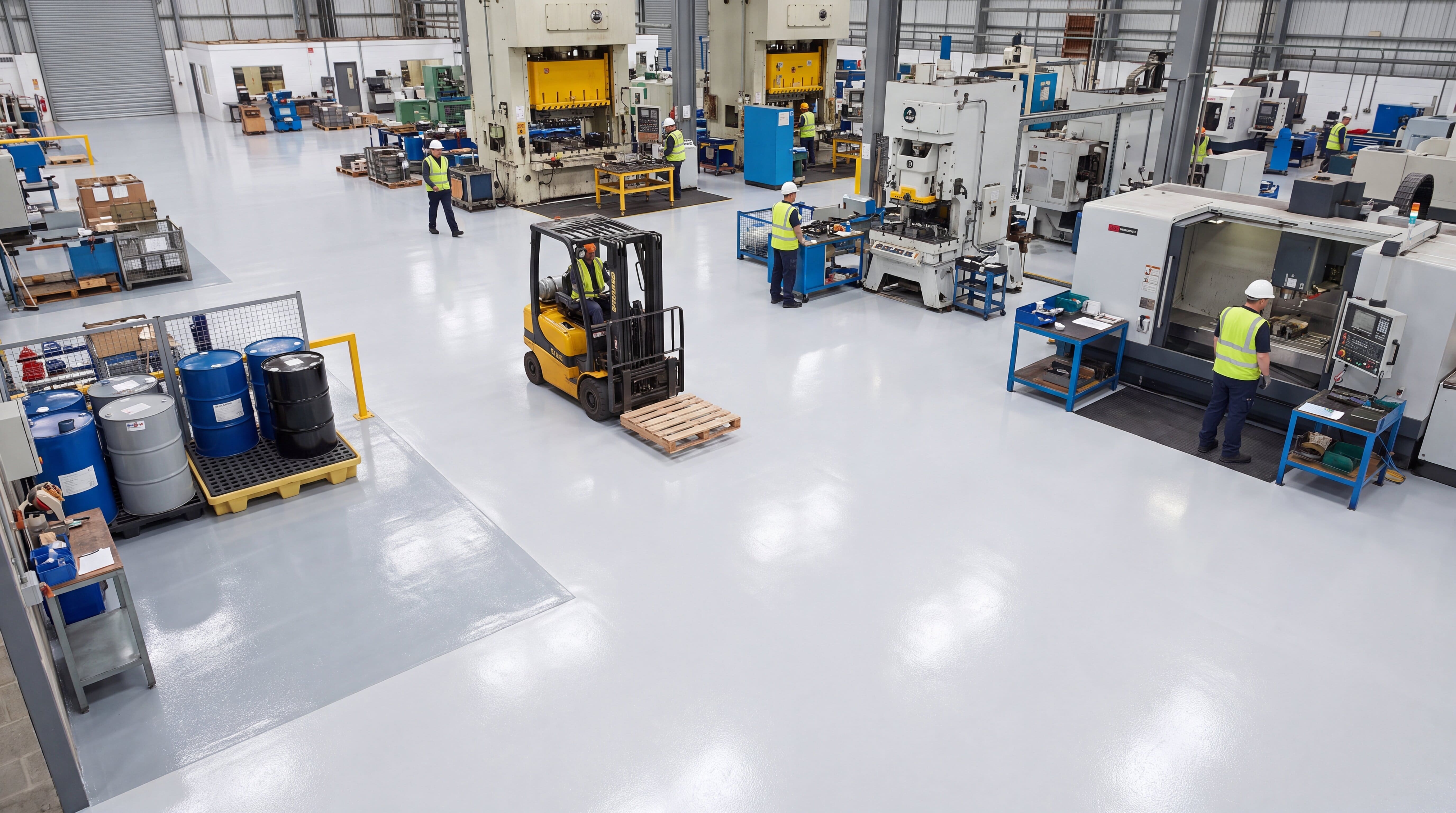
Industrial Resin Flooring in Surrey
The single most consistent problem we encounter across Surrey's manufacturing and engineering sector is businesses running standard floor paints that delaminate within months under forklift traffic, chemical spills, and point-loading from heavy machinery. Industrial resin flooring is a categorically different product. We specify high-build epoxy coatings and trowel-applied polyurethane screeds engineered to withstand compressive loads exceeding 70 N/mm², resist a full range of industrial chemicals including fuels, cutting oils, and alkalis, and outlast standard floor paint by a decade or more. We work regularly across Slyfield Industrial Estate in Guildford, Barwell Business Park in Leatherhead, and the Epsom Downs industrial area.
The thickness and system type we specify depends on the specific demands of the environment. A clean electronics assembly area with light foot traffic needs something fundamentally different from a heavy press shop with forklifts, dropped tooling, and hydraulic oil spills. On a recent project at an engineering unit on Slyfield Industrial Estate, the client had been through three rounds of floor paint in four years. We installed a 6mm trowelled polyurethane screed with a quartz anti-slip broadcast and sealed it with a two-pack PU topcoat. Two years on, it is unmarked. That outcome is only possible when the system is matched to the actual demands of the environment, not to the lowest cost option on the quote.
Industrial Resin Flooring in Surrey Installation Process
Heavy Mechanical Preparation
We deploy shot blasters or large planetary diamond grinders to remove existing coatings, oil contamination, surface laitance, and weak concrete. Industrial substrates frequently have deep oil contamination. We use specialist oil-tolerant epoxy primers on these areas, as standard primers will not bond to oil-saturated concrete. CSP 4 to 6 profile is targeted for high-build screed systems.
Structural Concrete Repairs
Expansion joints are assessed and rebuilt where damaged. Spalled and pitted concrete is cut square and filled with rapid-setting epoxy mortar to a minimum 60 N/mm² compressive strength. Structural cracks are chased open, cleaned, and injected with low-viscosity epoxy resin. All repairs are ground flush before the system is applied.
Priming
A two-pack epoxy primer, selected for the specific moisture level and surface profile of the substrate, is applied to consolidate the concrete and provide a chemically receptive base. In areas of high moisture, a DPM-grade primer rated to resist 4 bar hydrostatic pressure is specified.
High-Build System Application
Depending on the specification: high-build epoxy is applied by squeegee and back-roller to 500 to 1,000 microns DFT; or polyurethane screed is trowel-applied at 4 to 9mm thickness, incorporating quartz aggregate where anti-slip performance is required. Multi-coat systems allow colour topcoats to be specified in any RAL.
Demarcation, Curing, and Handover
Two-pack epoxy line marking is applied for pedestrian and MHE zones once the main floor has cured. Cure times are managed based on ambient temperature: industrial units are often cold, which slows cure. We measure temperature and humidity throughout the process and adjust working methods accordingly. Minimum 48 hours before forklift traffic at 20°C.
Systems and Options
Industrial environments require thick, chemically resistant systems, not decorative coatings:
- High-Build Epoxy Coating at 500 to 1,000 microns DFT: Applied by squeegee and roller. Suitable for medium-duty manufacturing, assembly areas, and clean production environments. Resists oils, fuels, dilute acids, and alkalis. Compressive strength of 70 to 80 N/mm². Anti-slip quartz broadcast available for wet process areas.
- Heavy-Duty Polyurethane Screed at 4 to 9mm: Trowel-applied at high build. Provides extreme impact resistance against dropped tooling and machinery, thermal shock resistance up to 120°C at 9mm, and superior chemical resistance to concentrated acids and alkalis. The correct specification for heavy engineering, press shops, and any environment with significant impact or thermal risk.
Benefits of Industrial Resin Flooring in Surrey
- Compressive strength of 70 to 80 N/mm², handles loaded counterbalance forklifts and heavy plant machinery
- Resists engine oils, cutting fluids, hydraulic oil, fuels, and dilute acids and alkalis
- Polyurethane screed at 9mm withstands thermal shock from steam cleaning and hot liquid spills up to 120°C
- Seamless surface eliminates joint failure, concrete debris, and dust generation
- Anti-slip profiles available from R10 to R13 for wet process and chemical handling areas
- Significantly outlasts standard floor paints: 10 to 15 years versus 1 to 2 years under industrial conditions
- Compatible with mechanical scrubber-dryer cleaning equipment
- Phased installation available to keep production areas operational throughout the works
Who Is Industrial Resin Flooring in Surrey Suitable For?
We work with factories, engineering workshops, heavy fabrication units, automotive component manufacturers, and aerospace maintenance facilities across Surrey. Slyfield Industrial Estate in Guildford and Barwell Business Park in Leatherhead are areas we visit regularly for survey and installation. The typical client is a production or facilities manager who has exhausted floor paint options and needs a system that will genuinely survive the demands of the environment.
We also work with commercial landlords and property developers preparing industrial units for new tenants across the Camberley, Farnham, and Redhill areas. In these cases, the requirement is usually a clean, dust-free coating applied to a bare new slab or a refurbished unit: a high-build epoxy in a standard mid-grey that presents well, seals the concrete, and gives the incoming tenant a floor they can work on immediately. Lead times from survey to installation are typically 3 to 5 weeks.
Frequently Asked Questions
Ready to Get Started?
Request a free, no-obligation survey and quote. We cover all of Surrey and the South East.