
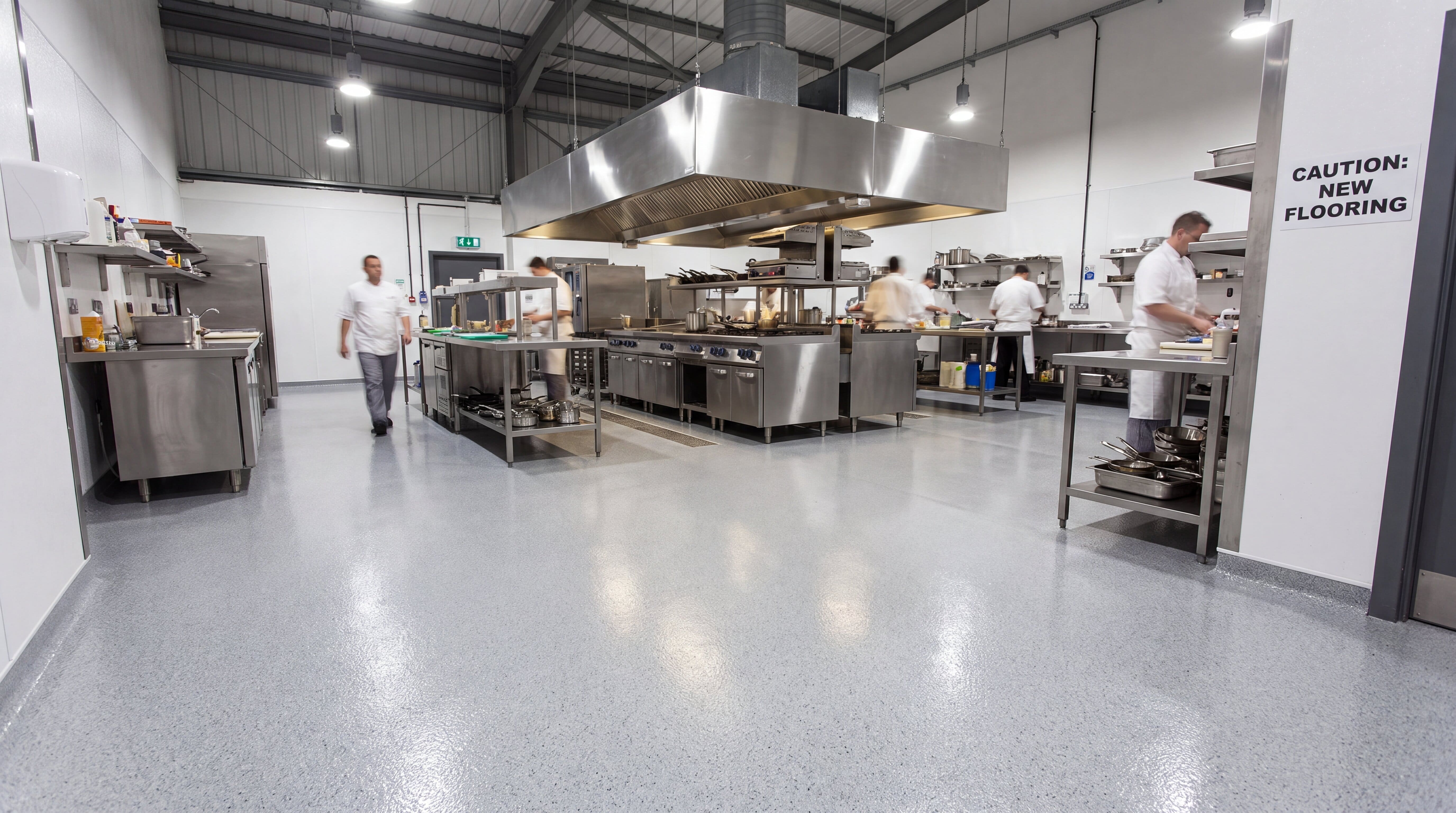
Commercial Kitchen Flooring in Surrey
Commercial kitchen flooring fails more often than any other resin application, and the reason is almost always the same: the wrong system was installed. Epoxy resin is rigid. When boiling water from a fryer or steam from a dishwasher hits a rigid epoxy floor, the sudden thermal expansion causes the resin to debond from the concrete in seconds. We have refurbished failed epoxy kitchen floors at restaurant sites across Guildford, Redhill, and the Epsom Downs area, all installed cheaply by contractors who did not understand thermal shock delamination. The correct material for a commercial kitchen is a heavy-duty polyurethane screed, a fundamentally different chemistry that expands at a rate close to concrete and is thermal-shock resistant by design.
In our 15 years working across Surrey's hospitality and catering sector, the specification is consistent: 6 to 9mm polyurethane screed with quartz aggregate broadcast to R11 or R12, coved skirting at 100mm height around the perimeter, and seamless integration around all drainage channels and gullies. This system meets HACCP requirements, withstands high-pressure steam cleaning, resists the organic acids and fats inherent to food production, and does not crack when a chef drops a stock pot of boiling liquid on it. Every other system eventually fails that test.
Commercial Kitchen Flooring in Surrey Installation Process
Substrate Preparation and Anchor Groove Cutting
We diamond grind the concrete substrate and cut anchor grooves around the perimeter of the kitchen and around all drainage channels. These grooves, typically 10mm wide by 10mm deep, lock the PU screed mechanically into the slab. Without them, thermal cycling gradually lifts the edges of the system over years of use.
Coved Skirting Installation
Before the main floor screed goes down, we form resin coved skirting at a height of 100mm around all perimeters, columns, and fixed equipment bases. This smooth 50mm radius curve eliminates the 90-degree floor-to-wall junction where grease, food debris, and bacteria accumulate and become inaccessible to routine cleaning.
Drainage Channel Integration
All stainless steel drainage channels and gullies are detailed meticulously. We cut anchor grooves around each drain, prime the exposed steel, and pack the PU screed tightly into the grooves to create a seamless, waterproof mechanical junction. Water is directed to the drain. None gets beneath the floor.
Heavy-Duty PU Screed Application
The polyurethane screed is mixed on-site and trowelled on at 6 to 9mm thickness, incorporating quartz aggregate for anti-slip performance rated to R11 or R12. The trowel finish is firm and consistent, not over-smoothed, as excess trowelling reduces aggregate exposure and lowers the anti-slip rating below specification.
Sealing and Cure Management
The completed screed is sealed with a chemical-resistant polyurethane topcoat that closes surface porosity without burying the anti-slip aggregate profile. Cure time to light foot traffic is typically 16 to 24 hours. Return to full commercial use with steam cleaning requires a minimum 5-day cure at 20°C ambient temperature.
Systems and Options
For commercial kitchens, the specification is defined by thermal and chemical demands, not aesthetics:
- Heavy-Duty Polyurethane Screed at 6 to 9mm: The only system we recommend for active food preparation areas. Thermally stable to 120°C at 9mm thickness. Resistant to lactic acids, citric acids, vinegar, animal fats, vegetable oils, and commercial cleaning chemicals including caustic soda and quaternary ammonium compounds. Compressive strength exceeds 50 N/mm².
- Antimicrobial PU Screed: The same system incorporating silver-ion technology in the resin matrix. Actively inhibits bacterial growth on the surface between cleaning cycles. Specified where food safety audits require active antimicrobial floor surfaces, or where the food type being handled creates elevated contamination risk.
Benefits of Commercial Kitchen Flooring in Surrey
- Withstands thermal shock from boiling liquid and steam cleaning up to 120°C at 9mm thickness
- HACCP-compliant: seamless, non-porous surface meets Food Standards Agency hygiene requirements
- R11 to R12 anti-slip rating maintained in wet, greasy kitchen conditions
- Coved skirting eliminates the floor-to-wall junction, the most common bacterial harbourage in kitchens
- Resists lactic acid, citric acid, animal fats, oils, and commercial kitchen cleaning chemicals
- Drainage integration provides waterproof, seamless junctions with all stainless steel channels
- Compressive strength exceeds 50 N/mm², withstands dropped heavy equipment without cracking or spalling
- Antimicrobial variant actively inhibits bacterial growth between cleaning cycles
Who Is Commercial Kitchen Flooring in Surrey Suitable For?
We install commercial kitchen floors for restaurants, hotel catering facilities, school and hospital canteen kitchens, production bakeries, dark kitchen operations, and event catering venues across Surrey. Guildford's hospitality sector, including hotel groups along the A3 corridor, is a regular client. We also work with institutional catering operations across Epsom, Redhill, and Farnham, where large-scale food service creates exactly the thermal shock and chemical exposure conditions that destroy inadequately specified floors.
Out-of-hours scheduling is standard for kitchen floor installations. Commercial kitchens operate seven days a week and cannot close for a 3 to 5 day installation during service hours. We work Friday night through Sunday, completing preparation, screed application, and sealing within the available window. A 6mm PU screed installation in a standard restaurant kitchen of 30 to 50 square metres typically takes one overnight session for the main floor, with a second overnight for the coved skirting and drainage detailing.
Frequently Asked Questions
Ready to Get Started?
Request a free, no-obligation survey and quote. We cover all of Surrey and the South East.