
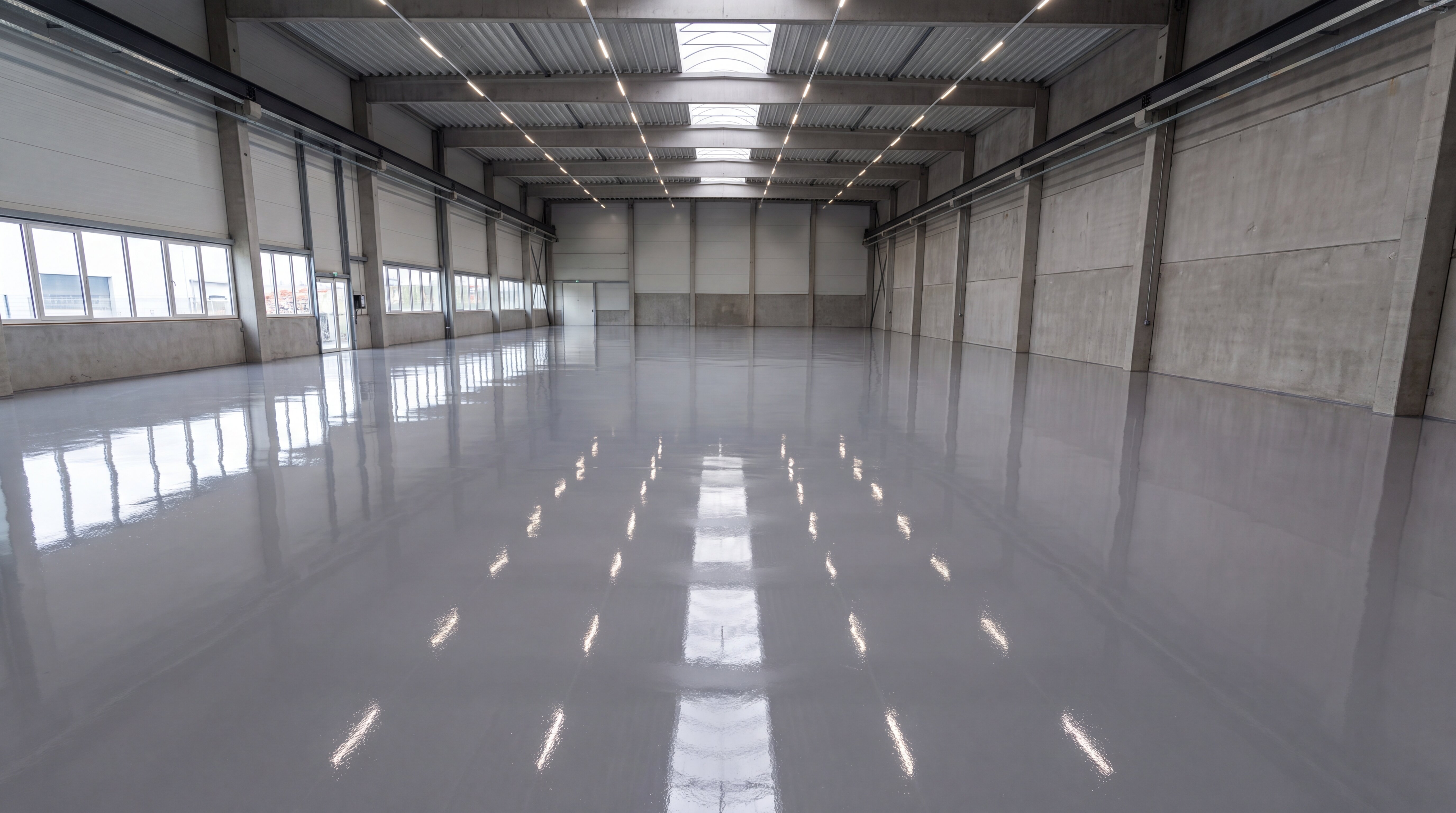
Resin Flooring vs Polished Concrete: Key Differences
Both offer an industrial, minimalist aesthetic. But when it comes to installation, comfort, and maintenance, they are completely different animals.
Installation Process
Polished concrete requires an existing, structurally sound concrete slab. The process involves grinding the concrete with progressively finer diamond abrasives to achieve a high-gloss finish. The final look depends entirely on the quality of the concrete poured below it—if the aggregate is uneven or the slab has cracks, the polished finish will highlight those flaws.
Resin flooring is a topical system poured or trowelled over an existing substrate (concrete, sand/cement screed, or even marine ply). It acts as a blank slate. We can install resin over imperfect floors by repairing the slab first.
Seamlessness and Hygiene
Concrete requires expansion joints to control cracking. Polished concrete leaves these joints exposed, creating areas where dirt and bacteria can accumulate.
Resin flooring is genuinely seamless. We can carry the resin over expansion joints using flexible sealants, creating a continuous, impervious surface. This makes resin vastly superior for environments requiring strict hygiene, like healthcare facilities or food manufacturing.
Repairability
If polished concrete cracks or stains deeply, it is exceptionally difficult to repair seamlessly. Patching concrete almost always leaves a visible scar.
Resin floors can be refreshed. Scratches on a polyurethane comfort floor can often be resolved with a new protective topcoat. Deep damage can be patched with new resin, and while color matching aged floors can be tricky, full recoats are straightforward and bring the floor back to brand-new condition.
Slip Resistance
Highly polished concrete looks spectacular but can be hazardous when wet.
Resin floors are highly customisable. We can incorporate quartz or bauxite aggregates into the top layers to achieve specific R-rated slip resistance profiles, essential for commercial wet zones or residential bathrooms.
Cost
The cost per m² can be similar, but context matters. For a large, newly poured warehouse slab, polishing the concrete is often highly cost-effective. However, for a residential renovation where the existing subfloor is uneven, bringing the concrete up to a polishable standard is very expensive. In those cases, a poured resin floor is usually more economical and provides a more predictable finish. Check our pricing guide for resin rates.
Summary Comparison
| Feature | Resin Flooring | Polished Concrete |
|---|---|---|
| Installation Time | Fast (2-4 days) | Slow (multi-step grinding) |
| Seamless | 100% seamless | Requires expansion joints |
| Repairable | Yes, easily recoated | Difficult to patch invisibly |
| Slip Resistance | Customisable to R12+ | Can be slippery when wet |
| Colour Choice | Unlimited (RAL/NCS matched) | Limited by aggregate/stains |
Frequently Asked Questions
Want the Concrete Look with Resin Benefits?
Explore our microcement and poured resin options.